WWII Battlefield Site - Military Relic Hunting in Estonia
During my first metal detecting outing in outside Sillamäe, I was exploring the woods along the sea-shore and discovered the remains of a WW2 German dug-out. It was situated at the end of the trench that ran on top of the huge rampart.
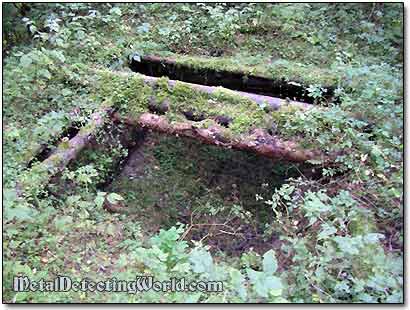
Then I was surprised to see more scars of the World War II, which were still visible 58 years later. I came across three lines of trenches stretched for a few miles along the shoreline. The forest was speckled with tank and artillery emplacements, dug-outs, fox-holes, and shell-holes.
German Artillery Emplacement
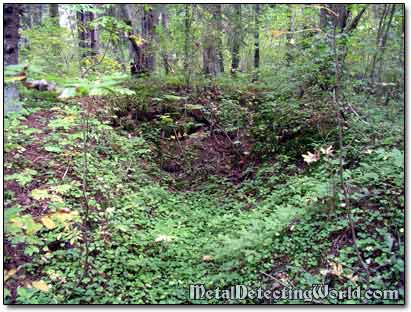
A Fox-Hole
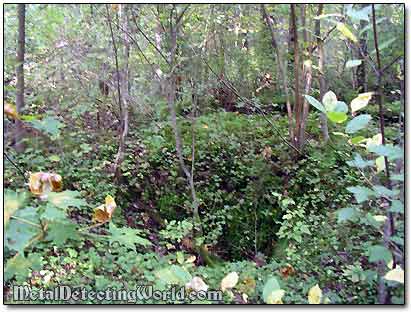
I was never interested in digging the WW2 relics. The reason for that was simple: it was unsafe. I had seen a few web sites that would describe the dangerous stuff that can be recovered and harm an inexperienced metal detectorist at the WW2 battlefield sites.
I was shocked to find out how much potentially fatal stuff was still buried underground. So called "military diggers" make their living by recovering and selling the valuable WW2 artifacts. A number of those diggers lose their lives every year. I certainly did not want to have "my boots hang on a tree branch one day" (a figure of speech), i.e. to be a statistics.
My choice had always been artifacts and coins from the older past. But this time, my curiosity took over and I decided to search the spot. When I turned my Minelab Explorer XS on, I got confused as I began receiving a cacophony of signals. I could not move a search coil an inch without getting a high-pitch signal. My first thought was that my machine was malfunctioning. I changed the Discrimination setting to accepting only silver and swung the coil over the same spot.
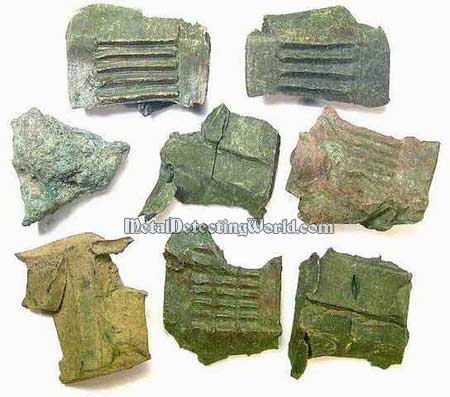
The number of signals was reduced to just a few. Still not believing in what I was hearing, I investigated one high-tone signal. To my surprise, it turned out to be a brass object of square shape and with jagged edges - a brass splinter - a fragment of the artillery projectile's brass belt.
I began to dig every high-tone signal and unearthed many more brass splinters. They were everywhere! Every inch of soil sounded off. I could not believe how much metal was present in the soil. If to imagine all that junk flying around during the battle, it was hard to think of anyone's survival. One cannot avoid digging these brass splinters because they give out a coin-like signal, and, therefore, would drive any metaldetectorist crazy!
Fragments of Artillery Projectile's Brass Belt
At that point, I realized that in the areas of former WW2 battlefields, a treasure hunter would not have a choice but to dig the WW2 military layer first in order to get to the older "cultural" layer. Considering the fact that most of the unwanted targets gave out the perfect coin signals, I knew that I had to dig every signal from now on. But it did not discouraged me at all. The challenge just got me more excited. And my Explorer was fine; it only required a little tune-up.