Halo Effect
What Causes Disappearance of a Coin-like Signal During Target Recovery, p. 1
Disappearance of a good signal occurs quite often during target recovery and is caused either by human error, or flaws in detector's electronic design, or sometimes just bad luck - all is described on next page. But the most occurring case of signal disappearance, as an odd phenomenon, is caused by... "various small insectivorous mammals of the family Talpidae" - moles... Oh, c'mon, I am just kidding! :))))... by so called "Halo Effect".
"A Solid Silver Coin Signal Is Gone Again!"

In scientific terms, the Halo Effect is a conductive increase in target size as seen by the metal detector's electromagnetic field. In simple words, the detector "sees" a small iron target as a large object and produces a FALSE signal, either high-pitched tone (if the Multi Tone ID audio is implemented) or just a coin-like signal, as if the object is non-ferrous and of high conductivity, i.e. made of copper or silver. The effect is caused by excessive target oxidation permeating the soil directly surrounding the target. The Halo Effect is ALWAYS associated with either long term burial of an object or highly acidic soils.
The Halo Effect immediately disappears upon digging up the iron target due to shifting and displacing of the soil surrounding the target - this causes the Halo to break instantly. It can be compared to bursting of an air balloon being pierced. In a similar way, you can destroy the iron targets's Halo Effect just by poking it with a coin-probe.
If the Discrimination is set on rejecting all iron (metal of the lowest conductivity), the metal detector will NOT respond to an iron object with a false high-pitched or coin-like signal after the iron object is disturbed and/or dug out. Instead, the audio Threshold will "blank" or "null" (this applies only to metal detectors operating in the Audio Threshold mode). As the iron object "gets" its true small size back and is rejected by the Discrimination circuit, the metal detector does not respond to it at all. And here is your phenomenal signal disappearance!
In All Metal Mode, when iron is ACCEPTED, the "silver" tone or coin-like response to a SMALL iron target changes to a low-pitched tone of iron (if the Multi Tone ID audio is implemented) upon digging up the target. The detector will not stop responding with a good signal ONLY to large iron targets even after they have been excavated. This is just the way all metal detectors work.
It is easier for an experienced detectorist with an advanced metal detector to deal with the Halo Effect than for a beginner using a cheap or outdated machine. However, there is a simple way to determine if the Halo Effect is involved in the good-signal disappearance. You need to set up the Discrimination level at least on "rejecting ALL nails", and utilize the Audio Threshold in your search program (make sure you do not utilize the SILENT SEARCH mode), i.e. you hear constant and barely audible humming of the Threshold during the search. The best situation is when you are metal detecting at the former homestead site that has never been plowed; therefore, all iron targets have been in the ground for quite a long time.
When you encounter disappearance of a good signal while recovering a target, just carefully listen to the Threshold. If the Threshold humming disappears ("blanks" or "nulls") for a fraction of a second when you move a search coil over the pile of excavated dirt or the dug hole, you sure have recovered an iron object which had had the long-developed Halo around it.
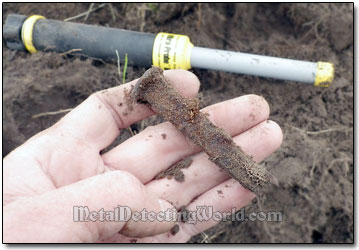
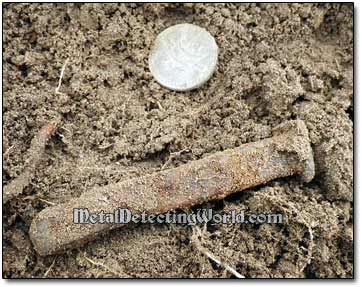
BUT, it does not mean you just walk away to the next target! This case may also involve both a REAL COIN and IRON NAIL if the nail has ended up on top of the coin in the dirt pile during target recovery and masked the coin out. It very well could be that you initially received a real (TRUE) coin response before you began digging the target up. So, to make sure you do not leave the valuable coin behind, you spread the dirt flat on the surface or ground cloth and scan it from different directions.
This Coin Was Masked by Nail