A Complete Guide To Cleaning and Preservation of Coins, page 16
HOW TO CLEAN SILVER and GOLD COINS: Effective Methods and Applications
The following methods can be used for cleaning silver coins:
1) Wet Cleaning: this treatment includes both the immersion of coins in warm soapy water for a few hours (the coins should be moved and turned over frequently) and rubbing wet coins with the fingers, using fine household salt (NaCl), sprinkled on most easily from a salt shaker. The salt's action is much more mechanical nature than chemical, because it can penetrate especially into the corners of the elevated coin parts or into the depressions. Some 10 % Ammonia solution (NH4OH) can be added to the cleaning water. Caution is advised for alloys; the coins should be examined every quarter hour with a magnifying glass.
2) Cleaning by Frozen Water Expansion (see details on page 6)
3) Cleaning with Brushes (see details on page 7).
4) Cleaning with Soft Erasers, a Toothpick, a Bone Stylus, and Ink Eraser (see details on pages 8 - 9)
5) Immersion into a Hydrogen Peroxide (H2O2) Bath, "Hydrogen Peroxide Bath" described on pages 11 - 12, is applied briefly to remove the dirt.
6) Immersion into 10% Ammonia (NH4OH) Solution Bath ("Ammonia Solution Bath" described on page 13): the coins should be immersed for a few minutes or continually taken out, soaked with several changes of water and brushed. Caution should be exercised with copper-bearing alloys; the coins should be examined every quarter hour with a magnifying glass.
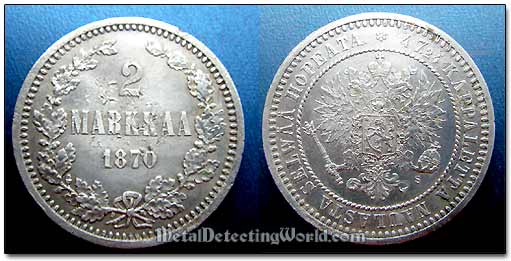
Great care must be exercised here as the coins might be damaged if they are exposed to the air for a long moment while being taken out of the ammonia bath for rinsing. In case of removal of horn silver (Silver chloride, AgCl), after brief rinsing the silver chloride can be removed with a brush. A short rinsing or soaking follows.
A Silver Coin Before Ammonia Bath Treatment
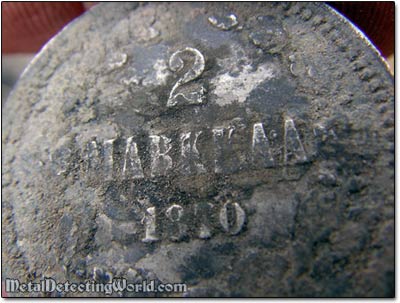
Finland 1870 2 Markkaa After Being Immersed in Ammonia Solution
7) Immersion into Lemon Juice: coins can be allowed to stand from a few to twenty hours in this. They should be inspected and turned over more frequently at the beginning. The coins should not lie above each other. A vigorous rinsing at the end suffices.
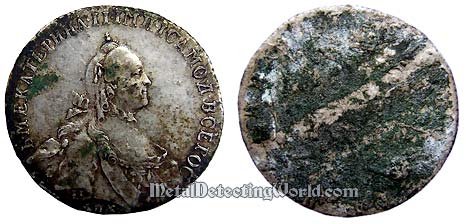
A Tough Case of Uncleaned Silver Coin Before Immersion in Lemon Juice
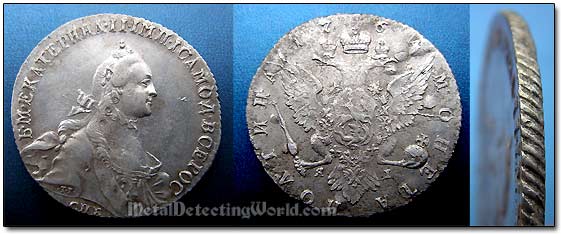
Same Coin - 1764 1 Poltina, After Being Cleaned
8) Immersion into Vinegar ("Vinegar and Salt Bath" described on page 13). Again, follow with a final rinse.
9) Immersion into Dilute Sulfuric Acid (H2SO4): use a dilute solution of one or two percent. The coins must be continually taken out, rinsed and brushed.
CAUTION: DILUTION OF SULFURIC ACID MUST ALWAYS BE DONE BY POURING ACID INTO WATER IN A FINE STREAM, NEVER by pouring water into concentrated sulfuric acid!
10) Immersion into Dilute Hydrochloric Acid (HCl): use a dilute solution of three to five percent. The coins must be continually taken out, rinsed and brushed. Alloys containing considerable copper are soaked for half hour with several changes of water.
11) Immersion into Alcohol Bath: Spirit, Methyl Alcohol. Not to be used for gold.
12) Immersion into Gasoline Bath.
13) Cleaning with Aluminum Foil is a simplest version of the Elctrochemical Reduction cleaning method (see #16 below) for removing tarnish from silver coins.
NOTE: Do not use this method on silver coins of high value.
A silver coin is placed into a strip of folded aluminum foil, shiny side inward. The foil and silver coin should be moistened separately with water before placing the coin inside the foil. Once the silver coin is surrounded by the foil, quickly press the foil into the coin's relief.
CAUTION: Do not keep fingers on the aluminum foil for too long. The chemical reaction between the foil, water and oxidized silver may create high temperatures and possibly burn your skin.
The chemical reaction will last for several minutes and may produce an odor similar to rotten eggs. After the coin cools down, peel the aluminum foil away from the coin. Black oxide can be easily rinsed off and the coin dried with a soft cloth. Coins with extensive oxidation may not respond completely to this method.
14) Removal of Dirt Encrustation by Immersion into Boiling Water with Washing Soda: Dirt encrustation involve coatings originating from external sources and not representing any change in the coin metal itself. The simplest method consists of boiling these coins in water to which some Washing Soda (Na2CO3) has been added. The coins are rinsed then, rubbed with common salt while still wet, and again rinsed.
A very effective method is to boil the coins in dilute sulfuric acid (H2SO4, diluted 1:10) for five minutes, followed by rinsing and rubbing of the still moist coins with common salt. The coins then should be soaked or rinsed several times. Caution must be exercised if a silver alloy has a high copper content.
NOTE: COPPER MAY NOT BE TREATED WITH SULFURIC ACID AT ALL!
15) Removal of Hard Incrustations by Immersion into Heated Mix of Lemon Juice and Olive Oil (this cleaning method is described on page 13).
16) Removal of Tarnish by Electrochemical Reduction by far is the most effective cleaning method described on page 15 and is covered in my detailed and illustrated Tutorial - "Galvanic Cleaning of Tarnished Silver Coins": the black tarnish can be removed when a silver coin becomes a part of a galvanic cell - aluminum foil + coin + electrolyte (baking or washing soda, or both, dissolved in water) + vat, which is heated to speed up Redox reactions. The orange red copper oxides or verdigris on a silver coin can be removed by suspending silver coin in a galvanic bath of copper sulfate solution; the coin forms the positive electrode (anode).
17) Electrochemical Reduction of Horn Silver (Electrochemical Reduction is described on page 15 and is covered in my detailed and illustrated Tutorial - "Galvanic Cleaning of Tarnished Silver Coins") with iron nails and lemon juice: the coins with horn silver are placed between iron nails (the coins should not touch one another) over which lemon juice is poured - another galvanic cell but with different components. The coins must be taken out from time to time, rinsed and brushed. Here is an example of a silver coin being cleaned by this method.
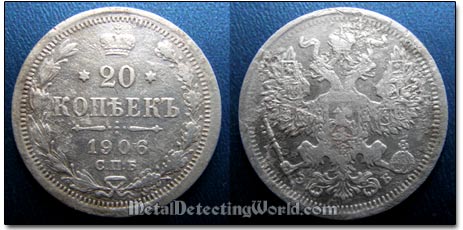
Another Tough Case of Copper Alloys Having Undergone Heavy Corrosion in Highly Mineralized Soil
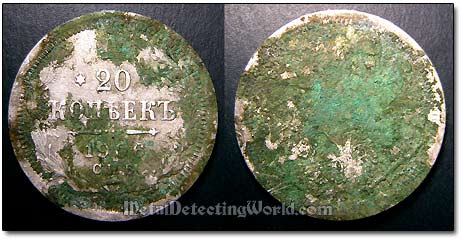
The Same Coin After Being Cleaned
Horn silver can be also removed by reduction with zinc chips and sulfuric acid (H2SO4). It is carried out as above, with the coins placed in zinc chips (zinc grains, in the rapid method) or between zinc pieces (also old coins, in the slow method). The zinc must touch coins on both sides. Sulfuric acid of two- to five percent is then poured on them. The hydrogen evolved loosens the silver chloride. If the silver chloride is not completely removed, the process can be repeated.
At last, horn silver can be removed by immersion in Sodium Thiosulfate solution (Na2S2)3, fixing salt, for about a half hour. This treatment does not damage the silver. It is followed by rinsing and soaking.
Coins should not be left unchecked, for example overnight, in a bath.
18) Removal of Hardest Deposits and Encrustations by Electrolysis - the "last resort" (Electrolysis is described on page 15 and is covered in my detailed and illustrated Tutorial - "Cleaning Coins with Electrolysis"): a coin is placed into an electrolytic cell - Vat + Anode + Cathode (with the coin attached) + Electrolyte (Baking soda dissolved in water) + External Power Source, and external direct electric current is applied to the electrolytic cell to drive Redox reactions.
You may want to learn my Simple and Quick Method for Cleaning Silver Coins of High Silver Content.
HOW TO CLEAN GOLD COINS
Gold does not oxidize, except for an extremely thin film invisible to the naked eye, is not attacked by any acid except Aqua Regia (described on page 21), and does not combine with sulfur. Because pure gold is never present in coins, some minor discoloration sometimes occur with gold.
The following methods can be used for cleaning gold coins:
1) Mechanical Cleaning: More care against surface damage is necessary with gold than with silver because the former is softer.
2) Wet Cleaning: This treatment includes both the immersion of coins in warm soapy water for a few hours (the coins should be moved and turned over frequently) and rubbing wet coins with the fingers, using fine household salt (NaCl), sprinkled on most easily from a salt shaker. The salt's action is much more mechanical nature than chemical, because it can penetrate especially into the corners of the elevated coin parts or into the depressions. Some 10% Ammonia solution (NH4OH) can be added to the cleaning water.
3) Chemical Cleaning: Because gold coins tarnish differently than silver coins, the chemical cleaning methods for silver coins may not be applicable. Usually to restore luster on a gold coin, all you have to do is to just wash the coin with soap under running water, then buff it dry with a jeweler’s cloth.
