My Experience with Some Reputed Metal Detectors of Yesteryear, p. 2
Illustrated reviews of metal detectors that I have successfully used in the past.
Each metal detector reviewed on the list below was, in its time, my go-to detector bringing remarkable results. Since I started metal detecting in 1993, there have been several significant improvements in VLF metal detector technology. Every time a new metal detector with a truly effective, revolutionary innovation was released on the market, I tried to get my hands on it and use it intensively until a new game-changing device appeared on the market.
No doubt, today's detectors have features and modes never dreamed of before; however, some older renowned machines are so capable that can be still successfully used. A few of them are still in my arsenal.
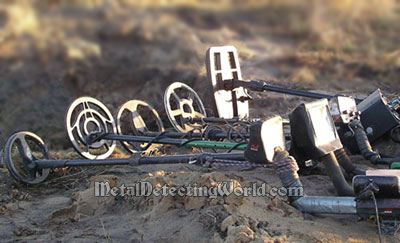
Part 2 - Metal Detectors I Have Used in the Past:
XP Deus (2012 - 2023)
This fully wireless metal detector appeared on the market in 2009 and got many detectorists excited. But then, a few years later, many users turned away from this machine because of its increasing complexity with each new firmware version, the steepest learning curve, flawed firmware and high price.
XP Metal Detectors provided me with two free Deus metal detectors (the first in 2012 and the second in 2014) for field testing and review, and I decided to put in the time and effort necessary to learn the ins and outs of this complicated metal detector. From 2012 to 2014, my girlfriend and I used the Deus v2.0 which we "duplicated", i.e. we made two Deus detectors from one, so that each of us had a detector with the same capabilities (see details HERE).
My girlfriend used her Deus (v2.0 and v3.2) from 2012 to 2019 until its 'tired' built-in battery stopped allowing her to search for more than 3 hours per hunt. Eventually, my girlfriend switched to Teknetics T2+ (discussed above).
I used my Deus v4.1 from 2014 to 2023 until its 'exhausted' built-in battery lost most of its battery life, and I acquired the Nokta Legend metal detector (discussed above). The Deus v4.1 is less stable and more complicated than the v3.2, but allowed me to achieve satisfactory results with either the 9" HF ('white') or 9" DD legacy ('black') searchcoil. Since the Legend proved its ability to outperform the Deus in all metal detecting situations in 2023, I have since resorted to using the ultra-lightweight Deus only for quick hunt site reconnaissance as long as the battery lasts. When the battery dies, I use the Legend or Teknetics T2+ fitted with my homemade detector harness which provides comfortable hunting.
• The pros and cons of the XP Deus metal detector are discussed in this 2-page article/review: XP Deus Review
I wished that XP provided Deus users with an opportunity to download and install the earlier firmware version - v2.0, because it was the most stable, suitable and efficient for coin and relic hunting in trashy sites of former homesteads. But XP removed the v2.0 option from the list of firmware downloads in 2017, and I still regret that I did not keep the fantastic v2.0 on at least one of our Deuses.
I tried some firmware versions released after v4.1, but they all turned out to be very unstable, more difficult to handle and less efficient. As for some previous versions, the v4.0 was a complete fiasco!
• My second detailed review covering some aspects of the v4.0 and v4.1 versions is posted on my 'XP Deus Reviews' Page
• My lengthy article - The Truth about XP Deus Metal Detector, sheds light on a development strategy, business plans and marketing tricks of XP Metal Detectors in regard to its main products - XP Deus 1 and XP Deus 2 metal detectors. This 7-page write-up also describes my own experience and experiences of other users of the Deus V3.2-V5.X.
If you treat the Deus (and Deus 2 too) like a "turn-on-and-go" detector, you will only have mediocre results and frustration. It is worth noting that although this detector has several factory-preset search programs, they should not be used for serious metal detecting on a regular basis. They only enable a user to start metal detecting under various conditions and achieve some results without additional adjustments of the program settings. The main purpose of the factory presets is to help a beginner user become familiar with the overcomplicated Deus at the beginning of the learning process.
It is best not to tinker with the factory preset programs until you understand all the settings of this metal detector and get the experience and confidence to do any tinkering. Otherwise, before you know it, your Deus will be very much all scrambled up and doing very little because altering just one aspect of the performance had a knock on effect elsewhere. All of the Deus settings affect each other.
The second purpose of each factory preset program is to serve as a basis for creating your own customized program based on specific algorithms incorporated into that factory preset. Such algorithms are designed for specific search conditions and/or metal detecting tasks. For example, if you need to create your own program for detecting deep coins and relics, you use the factory-preset 'DEEP' program. Then you optimize your customized program through fine-tuning it to the current search conditions at the hunt site.
To get the most out of the Deus (and Deus 2 too), it is necessary to have a substantial practical knowledge of the Deus features and modes in order to create the optimal combination of them - a customized search program, that will be most effective for the existing metal detecting conditions. Only such a program, along with fine-tuning the Deus for a specific detecting situation, will ensure maximum of good finds at the hunt site. In other words, the user must know what settings to tweak to accommodate the current trash, ground and EMI conditions, as well as the types of sought targets that are present in a given search area.
It usually takes a beginner at least 5 detecting seasons to master the Deus, i.e. to learn its key features and modes, and how they interact with one another. The learning process is so long due to many adjustable features, functions and modes to choose from. Their multitude obviously causes a high likelihood of user error, especially when fine-tuning the Deus.
Considerable practical experience is needed to avoid simple but critical mistakes when fine-tuning the Deus. Such experience can be gained through experimentation and analysis of the results obtained in the field. However, the learning of all the intricacies of the Deus will go faster if you get all the essential theoretical knowledge of this overcomplicated device.
If you are a beginner Deus user, you can get such knowledge from my write-ups on the Deus, that are all compiled in this directory - Articles on XP Deus Metal Detector and Accessories
After field testing, experimenting and using the Deus regularly for 11 years, I have accumulated enough practical knowledge about this detector to write over 16 articles, including tutorials and guides, that have been helpful to many Deus 1 and Deus 2 users around the world.
Despite a few shortcomings of the Deus and disadvantages of its interface, battery charhing system and headphones, it remained the most versatile and capable metal detector on the market until the more advanced multi-frequency machines came out. That was when the XP Deus 1 era was over. I put my Deus v4.1 away in the closet and only take it out when I need to reconnoiter an unfamiliar search area.
Other Metal Detectors
- Pulse Star II Pro (2006 - present)
This review describes the most effective detector in its class of Pulse Induction deep seeking units that easily detect sizable treasures 2 meters deep and ignore any mineralization. - XP GoldMaxx Power
This review describes pros and cons of a legendary analog detector-model which was a predecessor of XP Deus, and is still quite popular among coin shooters and hunters for non-ferrous relics. - Minelab E-Trac
This review describes the best detector-model ever produced by Minelab, and gives a few links to my in-depth tutorials and articles on this superb machine. - Garrett Ace 250
This is a short story of a successful, one-time joint hunt which my female companion Galina and I conducted while sharing the Ace 250 at a fantastic hunt site. - Tesoro Cortes
This review describes the most reliable and everlasting metal detector one can imagine. - Minelab Explorer II
This short review reflects pros and cons of Minelab detectors of the Explorer series, which started the Minelab's 10-year domination on the market in 2000. - White's Spectrum XLT
This is a one-page recollection of great metal detecting times I had with this fantastic detector which not only incorporated a few innovations back in the early 1990s, which are coming back now in the latest detector-models, but also taught me a lot about what an advanced metal detector with remarkable customization can do. - Garrett Grand Master Hunter CX-II
This was my first metal detector which got me addicted to metal detecting during my first time out with it, in fact, upon digging up my first target - a silver Mercury dime!
NOTE: Not all metal detectors that I have are listed in a table above. Usually, if a recently released metal detector successfully passes my field tests and proves to be effective and suitable for my metal detection objectives, I am willing to write and post my detailed review of a worthy device in this section.
In Brief:
by Sergei UpstateNY, proficiency level: Beginner, last time modified:
Between the mid-1990s and mid-2000s, quite a few metal detectors with new, advanced technologies appeared on the market. Some of them met claims made by their manufacturers and performed better than the rest, and I certainly tried to acquire any of those machines for field testing and treasure hunting. A couple of manufacturers were generous enough to provide me with their best machines at that time. I used every detector I received as long as possible to fully master it and then get the best performance out of it. At the same time, I continued to monitor the market for cutting edge innovations as well as improved versions of today's leading metal detectors.
Usually, when a new and improved machine is introduced to the market, I monitor the Internet for real user reviews and opinions on this machine for one year. This is the best way to find out whether or not this device is a breakthrough technology that delivers better performance and more opportunities. And only then I am ready to acquire it if I can. Thus, my entire metal detecting experience can be divided into several time periods. Each period was dedicated to a specific metal detector that I regularly used. Until the end of 2018, there were four such periods. The detectors involved were Spectrum XLT, Minelab Explorer (2 models), Minelab E-Trac and XP Deus.
Each of these metal detectors proved to be quite effective in its time. I have also kept some less advanced machines because they are preferred by my friends and relatives who often use these metal detectors during our joint hunts. Or I myself have used them as backup or auxiliary devices.
The above-listed pages include my reviews of detectors I used and still use, a few practical tips in regards to their operation, and some pictures of finds made with these machines that have been very popular in the US and around the world over many years.
Author Info
Sergei UpstateNY is the founder, designer, content writer, photographer and editor of MetalDetectingWorld.com. His main specialization is field testing of metal detectors and accessories provided by manufacturers in exchange for detailed test reports and articles published on this website. His extensive experience spans coin cache hunting, coin cluster hunting, coin shooting and relic hunting. Occupation: potato digger in farm fields.